

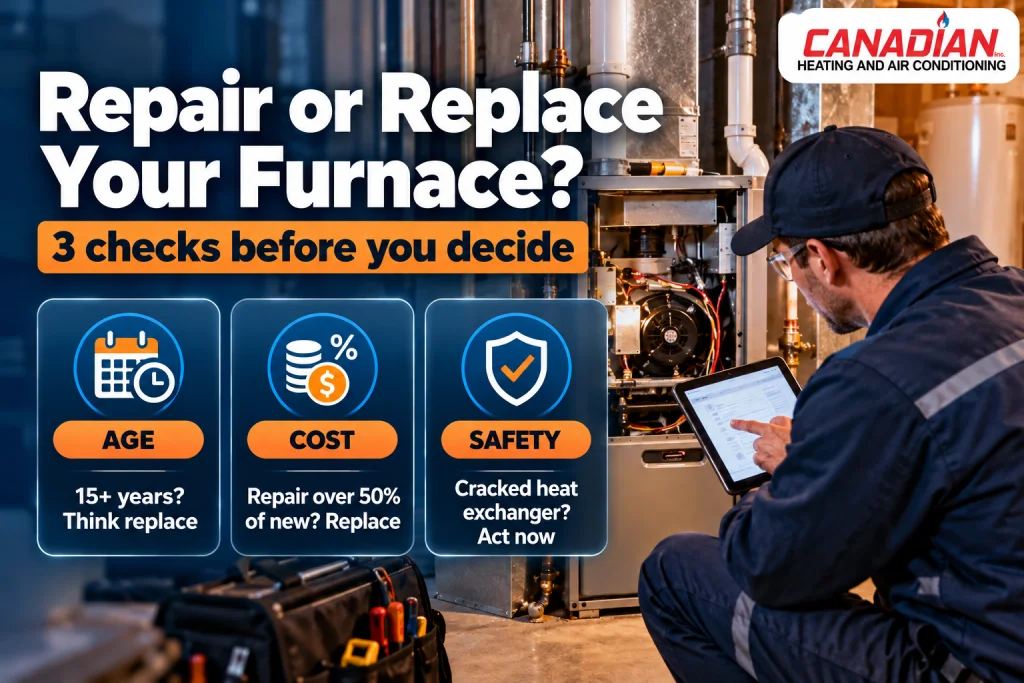
Deciding whether to repair or replace your furnace comes down to three checks: how old it is, what the repair costs compared with a new unit, and whether the problem affects safety. Repair a furnace under about 10 years old with one failed part. Replace one that is 15 years or older when repairs keep repeating or the quote passes half the price of a new furnace.
Repair if
Under 10 years
One failed part, no safety concern
Replace if
15 years or older
Repeat repairs, or a quote above 50% of a new furnace
Act now if
Safety warning
Cracked heat exchanger, carbon monoxide alarm or unsafe tag
Here is the short version of how to decide:
- Age: most gas furnaces last 15 to 20 years, so age tells you how likely the next repair is to be the last cheap one.
- Cost: the 50% rule compares one repair quote with the installed price of a new furnace.
- Safety: a cracked heat exchanger or a carbon monoxide warning overrides every cost calculation.
This guide walks through each check, the five signs that point to replacement, the signs that a repair is the smarter move, and how to get a written assessment before you spend either way. It applies to homeowners and to owners of shops, offices and other small commercial spaces with a forced-air furnace.
In this article
- Repair or replace your furnace: the quick decision rules
- Furnace age: when to repair or replace your furnace
- The 50% rule: is a furnace repair worth it, or time to replace?
- 5 signs your furnace needs replacement
- When repairing your furnace is the smarter move
- Safety problems that settle the repair or replace furnace question
- If you own a business or commercial space
- 3 furnace care tips that delay replacement
- A four step checklist before you decide
- Furnace repair and replacement across Halton, Hamilton and Brantford
- Sources
Repair or Replace Your Furnace: The Quick Decision Rules
Use this table as a first pass on whether to repair or replace your furnace, then confirm it with a written quote from a licensed technician. The right answer depends on the unit in your home or building, not on a rule alone.
| Your situation | Usually the better move | Why |
|---|---|---|
| Under 10 years old, one failed part | Repair | A newer furnace has years of life left, parts are easy to source and a warranty may still apply. |
| 10 to 15 years old, one small repair | Repair | The fix is cheap and the furnace is still inside its normal lifespan. |
| 10 to 15 years old, second major repair in a short period | Start planning replacement | Repeat failures show wear spreading across components. |
| 15 to 20 years old, repair above 50% of a new furnace | Replace | Repair money buys the least extra life at this age. |
| 15 to 20 years old, small repair | Repair, and budget for a replacement | The next large repair is likely closer than the last one. |
| Any age, cracked heat exchanger | Replace | This is a safety fault, and it usually cannot be repaired economically. |
| Over 20 years old and still running | Plan ahead | Replacing on your schedule lets you compare quotes instead of rushing one. |
Rules of thumb, not guarantees
Every rule for deciding whether to repair or replace your furnace is a starting point. A technician can measure what a rule cannot, such as the condition of the heat exchanger, the state of the venting and whether parts are still available for your model.
Furnace Age: When to Repair or Replace Your Furnace
Most gas furnaces last 15 to 20 years with regular maintenance. Heavy use, poor airflow and skipped servicing can shorten that. You can find the age on the rating plate inside the furnace cabinet, because manufacturers usually encode the build date in the serial number, and a technician can decode it for you.
| Furnace age | What to expect | Typical approach |
|---|---|---|
| Under 10 years | Good efficiency, parts available, warranty may remain | Repair single faults |
| 10 to 15 years | Wear starts to show in the blower, igniter and controls | Repair, and track what you spend |
| 15 to 20 years | Efficiency and reliability decline | Compare repair against replacement every time |
| Over 20 years | Beyond the typical lifespan | Plan replacement, and treat repairs as short term |
Age also affects efficiency. Under the federal Energy Efficiency Regulations, new gas furnaces now have a 95% AFUE minimum, furnaces built from 2010 to mid-2019 had a 90% minimum, and older units may be rated as low as 78% to 80%. Going from an 80% furnace to a 95% furnace cuts the gas you burn for heating by about 16%, so the efficiency gain adds to the money you avoid spending on repairs. Our furnace replacement cost guide shows what each price tier covers.
The 50% Rule: Is a Furnace Repair Worth It, or Time to Replace?
The 50% rule is the most common cost test when you decide to repair or replace your furnace. If one repair costs more than half the installed price of a new furnace, replacement is usually the better value. RenoQuotes puts a typical installed gas furnace replacement at $4,000 to $7,000, so a repair quote