

The most common furnace problems are a dirty filter, a thermostat setting, a failed igniter, a dirty flame sensor and a blocked vent pipe. Most of them show up as one of three symptoms: no heat at all, heat that cuts out after a minute or two, or a new noise. Match your symptom to the likely cause below, try the safe checks first, and call a licensed technician for anything that involves gas, burners or wiring.
Furnace is silent
Power or switch
Go to problem 3
Starts, then shuts off
Flame sensor
Go to problem 5
Stops in the cold
Vent or condensate
Go to problem 7
Three rules keep furnace troubleshooting safe and short:
- Check before you touch: the filter, thermostat, furnace switch, breaker and outdoor vent pipes are all yours to check.
- Stay out of the burner area: gas valves, igniters, flame sensors and heat exchangers belong to a certified technician. In Ontario, repairing a natural gas appliance requires a TSSA-issued gas technician certificate, and TSSA advises hiring a TSSA-registered contractor to install, service and inspect any fuel-fired appliance.
- Treat carbon monoxide as an emergency: an alarm that sounds means everyone goes outside first (more in problem 10).
This guide covers the 10 common furnace problems that send homeowners in Hamilton, Burlington and Oakville looking for a furnace technician each winter. It also covers two causes many lists skip: a blocked vent pipe and a frozen condensate line on high-efficiency furnaces.

In this article
Run This Five-Minute Check Before You Call Anyone
Several of the most common furnace problems have a simple cause you can rule out in about five minutes. Work down this list in order:
- Thermostat: set it to Heat, at least 3 degrees above the room temperature, and replace the batteries if the screen is blank.
- Furnace switch: a switch that looks like a light switch sits on or near the furnace. Confirm it is on.
- Blower door: the front panel must sit fully in place. A loose panel opens a door switch that cuts power to the furnace.
- Breaker: look for a tripped furnace breaker and reset it once. If it trips again, stop and call.
- Filter: pull it out and hold it up to a light. If you cannot see light through it, replace it.
- Outdoor vent pipes: a high-efficiency furnace has two white plastic pipes that exit an outside wall. Clear snow, ice or leaves from the openings by hand.
- Control board light: look through the small window on the blower door for a flashing LED. Count the flashes, match them to the code label near the window and write the code down.
If the furnace runs after these checks, you fixed it for free. If it does not, you now know which problem below to read first, and your technician starts with a code instead of a guess.
Match Your Symptom to the Likely Cause
Use this table to match what you see and hear to one of the common furnace problems below.
| What you notice | Likely cause | Read |
|---|---|---|
| Weak heat that improves with a new filter | Dirty or clogged filter | Problem 1 |
| Heat ignores the thermostat, or the screen is blank | Thermostat settings, batteries or wiring | Problem 2 |
| Furnace silent and the blower never starts | Power, switch, door switch or breaker | Problem 3 |
| Blower runs but the air stays cold | Ignition or gas supply | Problem 4 |
| Burners light, then shut off within seconds | Dirty flame sensor | Problem 5 |
| Furnace turns on and off every few minutes | Short cycling from airflow, sensor, vent or sizing | Problem 6 |
| Shutdown after snow, ice or freezing rain | Blocked vent pipe or condensate line | Problem 7 |
| Some rooms stay cold while the furnace runs | Airflow, ducts or sizing | Problem 8 |
| Banging, squealing, rattling or grinding | Blower, motor or loose parts | Problem 9 |
| Carbon monoxide alarm sounds | Combustion or exhaust fault | Problem 10 |
The 10 Common Furnace Problems and What to Do About Each
1. Dirty or Clogged Filter
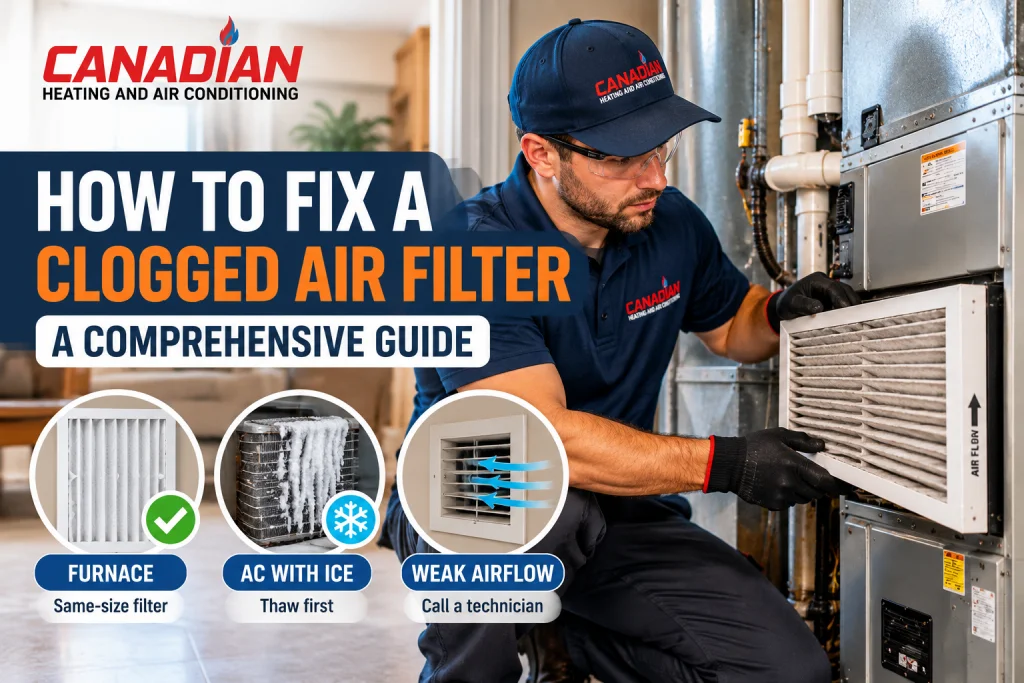
A clogged filter heads the list of common furnace problems and costs the least to fix. Restricted airflow makes the furnace overheat, which trips its high-limit safety switch and shuts the burners off early. You get weak heat or short cycling.
- Check monthly in winter: replace the filter when light no longer passes through it.
- Install it facing the right way: the arrows on the frame point toward the blower.
- Never run without one: dust builds up on the blower and inside the cabinet.
Timing depends on the filter type and your household, which we cover in how often you should change your furnace filter. For a step-by-step swap, see how to fix a clogged air filter.
2. Thermostat Problems
Among common furnace problems, this one is often not the